
Freezer Buying Guide Philippines: Chest vs Upright (2026)
Quick answer: Choosing between a chest freezer and an upright freezer comes down to how much space you have, how you organise your frozen goods, and what you use the freezer for. Chest freezers offer more storage capacity per peso and better energy efficiency. Upright freezers are easier to organise and access. For bulk buying families and small businesses, a chest freezer is usually the better value. For everyday household use where convenience matters most, an upright freezer is worth the premium.
Why Buy a Standalone Freezer?

The freezer compartment in a standard refrigerator is often too small for Filipino households that:
- Buy meat, fish, and seafood in bulk from wet markets or wholesale suppliers.
- Prepare meals in advance and store them for the week.
- Run a home business (sari-sari store, carinderia, baking, food delivery).
- Stock up during sales to save money on groceries.
A standalone freezer gives you dedicated frozen storage, better temperature consistency, and the flexibility to stock up without cramming everything into a tiny ref compartment.
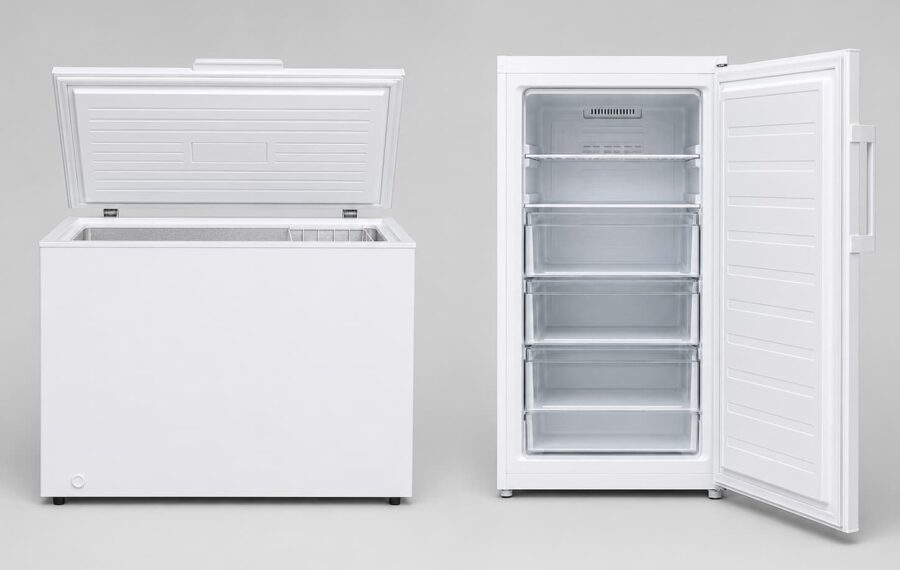
Chest Freezer vs Upright Freezer
| Feature | Chest Freezer | Upright Freezer |
|---|---|---|
| Shape | Wide and deep (top-opening lid) | Tall and narrow (front-opening door) |
| Storage capacity | More usable space per cu ft | Less total space but better organised |
| Organisation | Harder to find items at the bottom | Shelves and drawers for easy access |
| Energy efficiency | Better (cold air stays in when lid opens) | Lower (cold air falls out when door opens) |
| Floor space | Needs more floor area | Smaller footprint (vertical) |
| Defrosting | Usually manual defrost | Many models offer auto-defrost |
| Best for | Bulk storage, businesses, large families | Everyday household use, small kitchens |
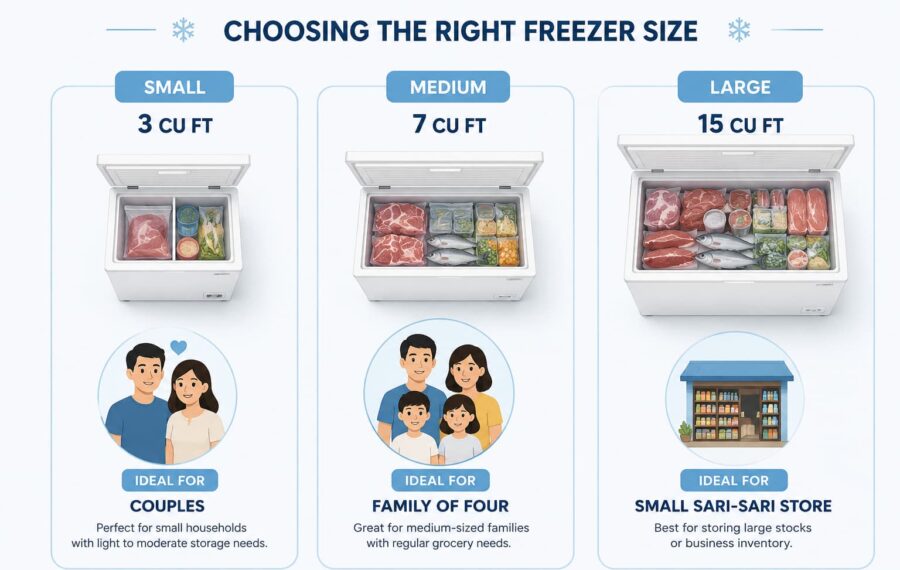
Choosing the Right Freezer Size
| Capacity | Best For | Typical Use |
|---|---|---|
| 3.0 to 5.0 cu ft | Solo or couple households | Extra frozen storage alongside a ref |
| 5.0 to 7.0 cu ft | Small families (3 to 4 people) | Weekly bulk buying, meal prep |
| 7.0 to 11.0 cu ft | Large families, home businesses | Bulk meat/fish storage, sari-sari inventory |
| 11.0 to 15.0 cu ft | Commercial use, carinderias | High-volume storage, multiple product types |
| 15.0 cu ft+ | Restaurants, wholesale operations | Commercial-grade storage |
💡 Rule of thumb: Allow about 1.5 cu ft of freezer space per person in the household. A family of 5 should look at 7.0 to 8.0 cu ft minimum.
Top Freezer Brands in the Philippines
Fujidenzo
One of the most popular freezer brands in the Philippines, especially for chest freezers. Known for affordable pricing and a wide range of sizes from 5.0 to 15.0 cu ft. A strong choice for sari-sari stores and budget-conscious families.
Condura
A well-established Filipino brand with a reputation for durability. Condura offers both chest and upright freezers with solid build quality. Their inverter chest freezer models are popular for energy-conscious buyers.
Haier
An international brand with a growing presence in the Philippine market. Haier offers both chest and upright freezers with modern features like convertible freezer-to-fridge modes and digital temperature controls.
Samsung
Samsung’s upright freezers are known for their sleek design and smart features. They sit at a higher price point but offer digital inverter technology and premium build quality.
LG
LG offers upright freezers with their Linear Inverter Compressor technology for energy efficiency. Good for households that want a premium upright freezer with a long warranty.
Key Features to Look For
Energy Efficiency
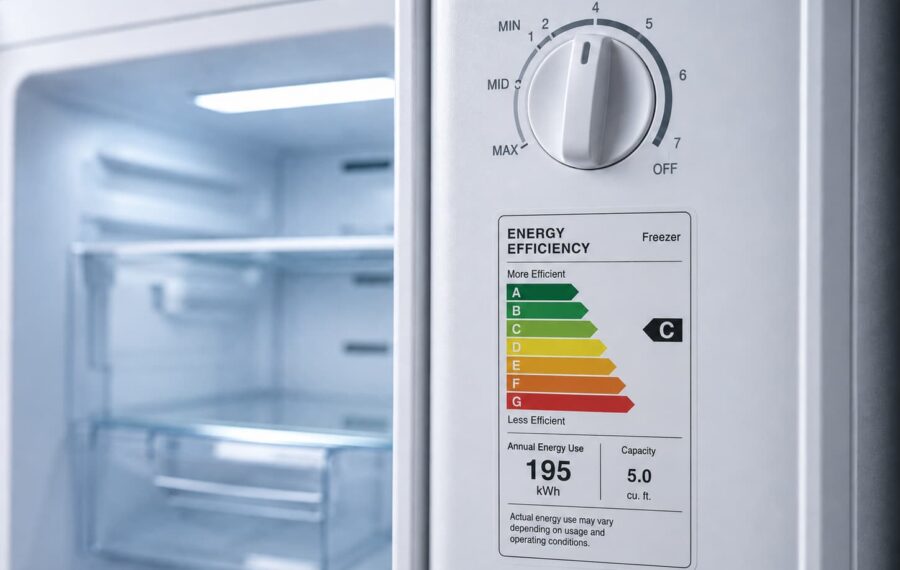
Freezer runs 24/7, so energy efficiency directly impacts your monthly electricity bill.
- Inverter compressor models use 30 to 40% less electricity than standard compressors.
- Check the DOE energy label (Philippine Department of Energy). Aim for 4 or 5 stars.
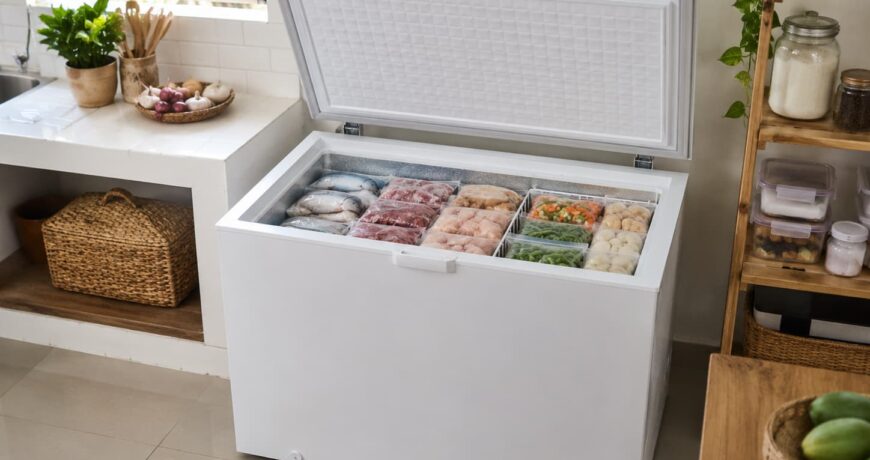
- Chest freezers are inherently more energy-efficient than uprights because cold air doesn’t escape as easily when the lid is opened.
Defrost Type
- Manual defrost (most chest freezers). Requires periodic defrosting (every 3 to 6 months depending on use). Ice builds up on the walls and needs to be melted and drained.
- Auto-defrost / frost-free (many upright freezers). The freezer automatically prevents ice buildup. More convenient but uses slightly more energy.
Temperature Control
- Adjustable thermostat lets you set the temperature based on what you are storing.
- Fast freeze function rapidly drops the temperature to preserve freshly added items. Useful when adding large batches of meat or fish.
Build Quality
- Thick insulation keeps the cold in and reduces energy consumption.
- Sturdy hinges and seals on chest freezer lids prevent warm air from entering.
- Removable baskets (chest freezers) make it easier to organise and access items.
- Lock and key is essential for commercial use or households with young children.
Chest Freezer Organisation Tips
The biggest complaint about chest freezers is that items get buried at the bottom. Here are practical ways to stay organised:
- Use the removable basket for frequently accessed items (ice cream, quick-cook meals, bread).
- Group items in labelled bags or containers. Dedicate sections: meat on one side, fish on the other, vegetables and prepared meals in the middle.
- Stack flat. Freeze items in flat bags so they stack neatly and maximise space.
- Keep an inventory list taped to the lid. Update it when you add or remove items. This reduces the time the lid is open (saving energy).
- Place newer items at the bottom and older items on top to ensure you use things before they get freezer burn.
How Much Electricity Does a Freezer Use?
Electricity consumption depends on the size, type, and whether the unit has an inverter compressor.
| Freezer Type | Size | Estimated Monthly kWh |
|---|---|---|
| Chest (non-inverter) | 7.0 cu ft | 25 to 35 kWh |
| Chest (inverter) | 7.0 cu ft | 15 to 25 kWh |
| Upright (non-inverter) | 7.0 cu ft | 35 to 50 kWh |
| Upright (frost-free) | 7.0 cu ft | 40 to 55 kWh |
💡 Tip: Keep the freezer at least 75% full for optimal energy efficiency. A full freezer retains cold better than an empty one. If it is not full, fill the empty space with water bottles.
Placement and Maintenance
- Location. Place the freezer in a cool, well-ventilated area away from direct sunlight. Avoid placing it next to a stove or oven.
- Clearance. Leave at least 10 cm of space around the back and sides for air circulation.
- Defrosting. For manual defrost models, defrost when ice buildup reaches about 5 mm thick. Unplug, remove items, and let the ice melt naturally (or use warm water to speed it up).
- Gasket cleaning. Wipe the door seal (gasket) regularly with a damp cloth to ensure a tight seal.
- Power surges. Use a surge protector, especially during storm season, to protect the compressor from voltage spikes.
Frequently Asked Questions
Is a chest freezer or upright freezer better for a home?
For most Filipino families, a chest freezer offers better value: more storage space per peso and lower energy costs. An upright freezer is better if you have limited floor space or want easier access to organised shelves.
How long does a freezer last?
With proper maintenance, a quality chest freezer can last 12 to 20 years. Upright freezers typically last 10 to 15 years. Inverter compressors generally have a longer lifespan than standard compressors.
Can I use a chest freezer as a refrigerator?
Some modern chest freezers (like certain Haier models) have a “convertible” mode that lets you switch between freezer and refrigerator temperatures. Standard chest freezers cannot be used as refrigerators without modification.
How often should I defrost a chest freezer?
Defrost when ice buildup reaches about 5 mm (roughly every 3 to 6 months for regular use). Excess ice makes the compressor work harder, increasing electricity consumption.
What size chest freezer do I need for a sari-sari store?
For a small sari-sari store, 8.0 to 11.0 cu ft is usually sufficient. For stores with higher frozen goods inventory (ice cream, frozen meat, ice), consider 12.0 to 15.0 cu ft.